
Vicarious trauma has been defined as “the transformation that occurs in the inner experience of the therapist [or worker] that comes about as a result of empathic engagement with clients’ trauma material” (Pearlman & Saakvitne, 1995a, p. 31). Pearlman and Caringi (2009: 202) define vicarious trauma as “the negative transformation in the helper that results from empathic engagement with trauma survivors and their trauma material, combined with a commitment or responsibility to help them”.
Undoubtedly, people working in the field of support are likely to be personally affected by hearing about traumatic events, and by witnessing the considerable impact and distress which this has caused. Working with people who have experienced profound trauma and injustice is complex. It can be experienced as a privilege, bringing an added sense of connection, value and meaning but it can also become personally draining, and at times extremely overwhelming. The effects of vicarious trauma vary from person to person. For some people, there may be a wide range of signs and symptoms, while others may experience problems in one particular area of their life.
“Within organisations, case law and legal statutes place specific requirements on the employer to provide and maintain a safe working environment and to keep abreast of current knowledge and research in the area of traumatic stress. In order to meet their legal responsibilities, organisations need to discharge their duties to develop a systematic approach to managing the risk of traumatic stress.” (Tehrani 1995).
Research by fatigue expert Francoise Mathieu (2012) evidences that between 40% and 85% of “helping professionals” develop vicarious trauma, compassion fatigue and/or high rates of traumatic symptoms.
Looking after the wellbeing of staff is not just a statutory responsibility, it can also offer economic benefit, through improved service management through reduction of staff absence.
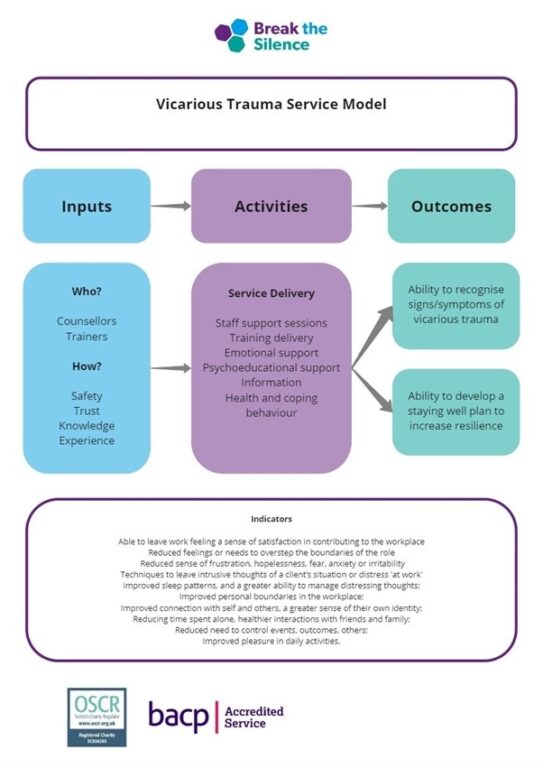
The impact of vicarious trauma tends to be cumulative and occurs over time and can impact on behaviour, performance, emotional, physiological and mental wellbeing, decision making. People experiencing vicarious trauma may experience: invasive thoughts of client’s situation, distress, frustration, fear, anxiety, irritability, disturbed sleep, nightmares, racing thoughts, problems managing personal boundaries, taking on too great a sense of responsibility or feeling they need to overstep the boundaries of their role, difficulty leaving work at the end of the day, loss of connection with self and others, loss of a sense of own identity, increased time alone, a sense of needing to withdraw from others, increased need to control events, outcomes, others, and loss of pleasure in daily activities.
Bessel van der Kolk, Psychiatrist, Author, Researcher and Educator, says “Trauma results in a fundamental reorganisation of the way mind and brain manage perceptions. It changes not only how we think and what we think about, but also our very capacity to think”. It is therefore likely that even people who don’t feel impacted by their work may actually be impacted by it without acknowledging this, and this can be evident from their behaviour in some of the examples provided above.
“The expectation that we can be immersed in suffering and loss daily and not be touched by it is as unrealistic as expecting to be able to walk through water without getting wet.” (Remen, 2006)
We are organisational members of the British Association for Counselling and Psychotherapy (BACP), working within the BACP Ethical Framework for the Counselling Professions and within the trauma-informed principles of safety, trustworthiness, choice, collaboration, empowerment and cultural consideration.
Our counselling support is BACP Service accredited – accreditation confirms that a service provider offers an accountable, ethical, professional and responsive service to clients, staff, volunteers and stakeholders.
Using our 20+years of experience and knowledge, we have developed support options for vicarious trauma including training and support services. The purpose of our training and support services is to help your staff to continue their important work responsibilities without any detriment to their mental, emotional and physical health and wellbeing, protecting them from, and reducing the risk of vicarious trauma.
Vicarious trauma training can be provided to organisations to support staff to:
• improve understanding of vicarious trauma
• recognise symptoms
• know how to respond – coping strategies/wellbeing plans
Our services offer a robust, therapeutic, proactive and preventative approach to vicarious trauma, promoting compassion satisfaction and empathetic concern.
We can offer training for groups and are happy to discuss provision of one to one support for your Team. Where geographical location may be a barrier, we can offer online training and support options.
We work collaboratively with the staff member, at their own pace, to improve their understanding/knowledge of vicarious trauma, warning signs, symptoms, to develop coping strategies, empowering staff to create a wellbeing plan to increase resilience to vicarious trauma in addition to promoting the following:
• Increasing self-observation
• Emotional self-care
• Physical and mental wellbeing
• Maintaining a healthy work/life balance
• Being realistic about what can be accomplished
• Boundaries – your responsibilities in your role
• Peer support and opportunities to de-brief
The benefits of our support includes:
• Reduced emotional strain: by fostering compassion and providing support helps staff manage the emotional impact of their work.
• Enhanced Well-Being: Staff learn to balance work requirements with therapeutic relationships.
• Improved Client Relationships: strengthens staff-client relationships, benefiting both parties.
• Risk Management: Staff are better equipped to handle risk-related behaviours.
We would be delighted to discuss your requirements further and to provide a costing for support based on your needs.
Email: sharon@breakthesilence.org.uk
If you would like to enquire about vicarious trauma training and/or support for your Team, please contact: sharon@breakthesilence.org.uk